AI-Enhanced Life Cycle Assessment (LCA) of Wood Wool Acoustic Panels
Digital Transformation of Environmental Assessment
Life Cycle Assessment (LCA) has become a foundational methodology for evaluating the environmental performance of construction products, including wood wool acoustic panels. Traditionally, LCAs have relied on static datasets, manual modelling, and retrospective analysis, limiting their usefulness during early-stage design and product development. The integration of artificial intelligence (AI) into LCA workflows enables dynamic data processing, predictive modelling, and rapid scenario analysis, allowing environmental performance to inform material decisions in real time rather than after specification.

Foundations of LCA for Wood Wool Acoustic Panels
Material Composition and System Boundaries
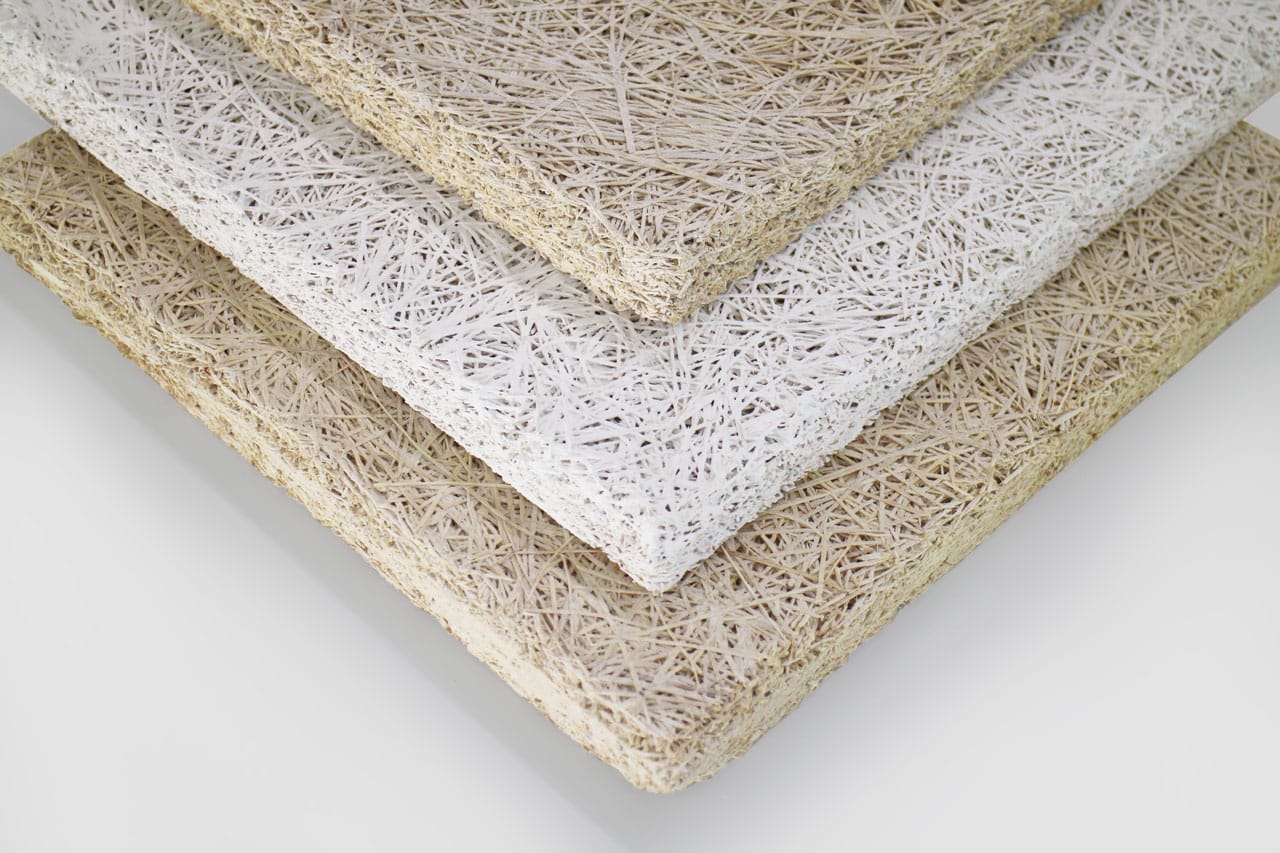
Wood wool acoustic panels are composite products formed from mineralised wood fibres bound with cementitious, magnesite, or emerging low-carbon binders. In LCA modelling, binder production frequently dominates environmental impact, often outweighing the biogenic carbon storage provided by wood fibres. Studies of wood-based insulation systems demonstrate that system boundary definitions—particularly cradle-to-gate versus cradle-to-grave—can significantly alter comparative results¹. AI-assisted boundary analysis can identify impact-intensive stages across large datasets, improving consistency and reducing modelling bias.
Data Quality and Variability Constraints
Environmental assessment of wood wool panels is complicated by variability in fibre moisture content, curing regimes, regional electricity mixes, and transport distances. Conventional LCA approaches struggle to integrate this variability without excessive simplification. Reviews of LCA data management highlight persistent challenges related to representativeness and uncertainty². Machine learning techniques can process heterogeneous datasets and detect statistically meaningful patterns, improving robustness without requiring excessive data aggregation.
Impact Categories Relevant to Acoustic Panels
While global warming potential remains the most cited LCA indicator, wood wool acoustic panels also raise considerations related to cumulative energy demand, particulate emissions, and mineral resource depletion. AI-enhanced LCA systems can dynamically prioritise impact categories based on product application, distinguishing between interior panels, semi-exposed installations, and façade systems. This contextual weighting enables environmental assessments that align more closely with functional performance requirements³.

Artificial Intelligence in LCA Workflows
AI techniques are increasingly applied to automate life cycle inventory generation, detect data inconsistencies, and accelerate environmental modelling. Machine learning algorithms can infer energy use and emissions from manufacturing parameters such as panel density, binder ratio, and curing temperature. Research shows that AI-assisted LCA can significantly reduce modelling time while maintaining acceptable accuracy compared to manual approaches⁴, enabling sustainability assessment to keep pace with product development cycles.

Predictive and Scenario-Based Environmental Modelling
Formulation and Process Optimisation
Predictive modelling allows AI-enhanced LCA to simulate how changes in material formulation or process efficiency affect environmental performance. For wood wool panels, this includes evaluating alternative binders, adjusting fibre-to-binder ratios, or integrating renewable energy sources. Studies on AI-driven sustainability assessment demonstrate that such predictive capabilities enable proactive environmental optimisation rather than reactive compliance⁵.
Early-Stage Design Integration
AI-enhanced LCA is particularly valuable during early-stage design, when material choices have the greatest influence on lifecycle impacts. By rapidly comparing scenarios, designers can identify environmentally favourable configurations before physical prototyping. This shifts LCA from a verification tool to a generative design input, supporting evidence-based specification decisions at the earliest project stages³.
Implications for Manufacturing and Disclosure
Environmental Product Declarations and Digital LCA
AI-enhanced LCA workflows align closely with the growing demand for Environmental Product Declarations (EPDs). Automated data pipelines allow environmental indicators to be updated as manufacturing conditions evolve, improving consistency across product families. Research on digitalised LCA frameworks indicates that AI-supported systems reduce administrative burden while enhancing data transparency².
Supply Chain and End-of-Life Modelling
Beyond manufacturing, AI-enhanced LCA can incorporate transport logistics and end-of-life scenarios. Machine learning models can evaluate alternative disposal, recycling, or recovery pathways based on regional data. Studies in sustainable construction modelling show that AI-supported scenario analysis strengthens decision-making around circular design strategies⁶, improving the credibility of environmental claims.
Toward Intelligent Environmental Assessment
AI-enhanced Life Cycle Assessment represents a significant evolution in how the environmental performance of wood wool acoustic panels is evaluated and communicated. By enabling faster modelling, improved data handling, and predictive scenario analysis, AI tools allow sustainability considerations to actively inform material formulation, manufacturing strategy, and specification decisions. Their effectiveness, however, depends on transparent methodologies, high-quality datasets, and alignment with established LCA standards. As regulatory frameworks move toward digital environmental disclosure and real-time sustainability metrics, AI-enhanced LCA is positioned to become a core component of responsible acoustic product development, supporting the transition of wood wool panels from inherently low-impact materials to fully optimised, data-verified building solutions.
References
Korjakins, A., Sahmenko, G., Pundiene, I., Pranckevicienė, J., & Lapkovskis, V. (2025). Development of a Mineral Binder for Wood Wool Acoustic Panels with a Reduced Carbon Footprint. Materials, 18(21), 4999.
Wang, H. (2025). Integrating machine learning into life cycle assessment: Review and future outlook. PLOS Climate, 4(10), e0000732.
Romeiko, X. X., Zhang, X., Pang, Y., Gao, F., Xu, M., Lin, S., & Babbitt, C. (2024). A review of machine learning applications in life cycle assessment studies. Science of the Total Environment, 912, 168969.
Popowicz, M., Katzer, N. J., Kettele, M., Schöggl, J.-P., & Baumgartner, R. J. (2025). Digital technologies for life cycle assessment: a review and integrated combination framework. The International Journal of Life Cycle Assessment, 30, 405–428.
Nwagwu, C. C., Ogorodnyk, O., Sølvsberg, E., Eleftheriadis, R. J., & Meskers, C. (2025). Integrating Artificial Intelligence into Life Cycle Assessment: A Framework for Balancing Automation and Human Expertise. Journal of Sustainable Metallurgy, 11, 3590–3605.
Plociennik, C., Watjanatepin, P., Van Acker, K., & Ruskowski, M. (2025). Life Cycle Assessment of Artificial Intelligence Applications: Research Gaps and Opportunities. Procedia CIRP, 135, 924–929.
Share